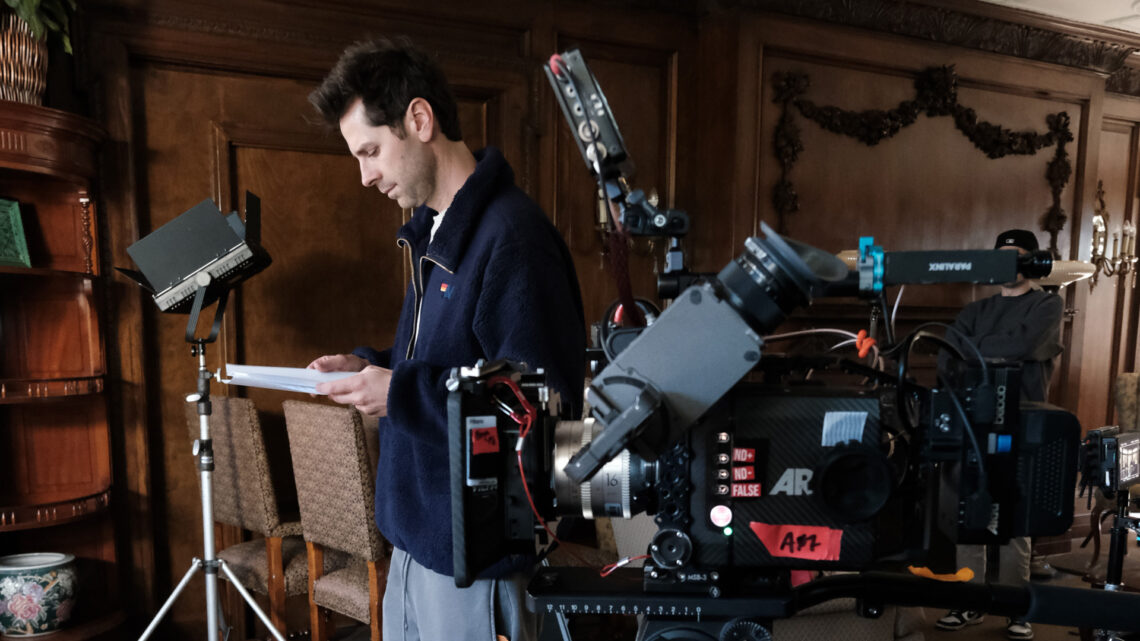

You could be a camera expert, or have never touched one.
You could obsess over your dialogue, or let the actors improvise.
You could storyboard everything, or work without a shot list.
There truly is no formula.
Believing there is a “right way” is what messes up so many filmmakers, especially when they are first starting out.
I’ve had many filmmaker friends over the years who have become enamored with Quentin Tarantino.
They listened to interview after interview. They heard him talk about how he writes scripts by hand without looking back to edit them. And naturally, they started to believe that’s how they are supposed to do it.
Meanwhile, other writers like Aaron Sorkin use completely different tactics – such as re-writing their films from memory to see which scenes they unconsciously leave out.
Other filmmakers I’ve met have been obsessed with David Fincher. They love how meticulous he is about visuals – often walking around set with his own light meter. Again, they try to emulate this.
But they could just as easily take after someone like Kevin Smith, who (especially early in his career) lacked that type of technical knowledge, and instead relied more heavily on his DP for guidance.
After Parasite won the Oscar in 2020, filmmakers became fixated on director Bong Joon Ho’s approach to storyboarding. They too wanted to be as meticulous as he was, which seemed to be a key to the film’s success.
But for every Bong Joon Ho, there is a Steven Spielberg who is known to work without a shot list. He comes up with his ideas on the fly and in the moment – which is part of his magic.
As much as we all wish there was some perfect formula, there is not.
That doesn’t mean you shouldn’t take inspiration from the processes of directors that you enjoy.
But it does mean you should avoid obsessing over someone else’s methods to the detriment of your own.
Ultimately what makes any of these directors great is their unique vision. Not just in the stories they tell, but in their approach to telling them.
By trying to copy someone else’s style of work, you lose the ability to develop a style of your own.
I learned this myself in recent years with regard to storyboarding.
Similar to the example I gave above, I was always fascinated with filmmakers who planned out their shots meticulously. So that’s what I did, because I thought I was supposed to.
But after experimenting on countless films over the years, I discovered one of my skills was improvising the coverage on set. It almost always resulted in better, more exciting, more spontaneous scenes.
And once I started embracing that, producers and other collaborators I would work with began to reinforce that approach. Telling me how valuable they found that skill for their own reasons.
Now, I almost always work without a shot list. Not because someone else does, but because it genuinely works better for me.
When you’re first starting out, you need to try everything and see what sticks. And taking inspiration from filmmakers you love is a great way to get going.
But ultimately, just as you need to find your own artistic voice, you need to find your own practical methods too – in prep, on set, and in post.
Try a bit of everything and you will quickly learn what is most intuitive to you, and what yields the best creative output.
For exclusive filmmaking articles every Sunday, sign up for my newsletter here!



8 Comments
Invosmith
atYour explanation that “Meanwhile, other writers like Aaron Sorkin use completely different tactics – such as re-writing their films from memory to see which scenes they unconsciously leave out.” gives readers a concrete point to consider. What example or limitation would you add if you updated this today? Disclosure: I work on
invoicing with Invosmith , a separate invoicing tool.
FHA Loan Estimator
atEvery tool on PPFocus is designed to be simple, fast, and reliable. c9727cce.
Guest Reader
atThanks for the clear explanation in There Is No One Way To Be A Director – Noam Kroll. I found a complementary resource here: https://www.fipst.com/.
theplayerstats.org
atKeep up the great work.
태국유흥
at파타야유흥
rehman ali
atHi,
I’m interested in a guest post on your website: https://noamkroll.com/
Please share your prices for casino guest posts and link insertions.
Best regards,
free crm
atvery informative articles or reviews at this time.
Manuel Shaw
atIn addition to being entertaining, the game Geometry Dash Lite aids in the development of critical abilities including patience, focus, and hand-eye coordination.