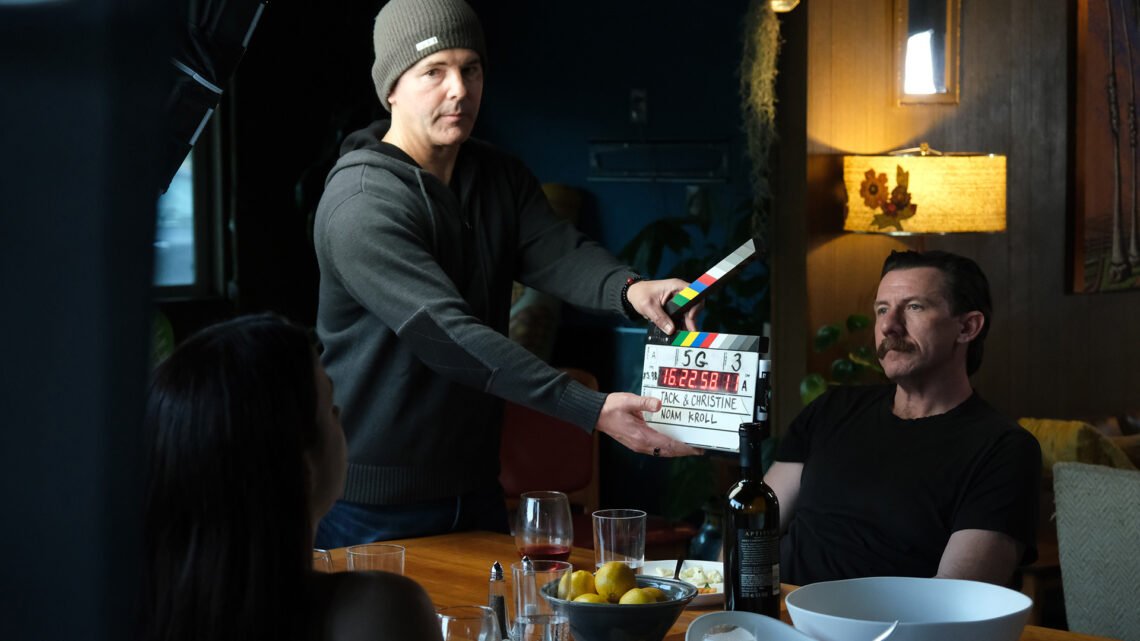

This month I’ll be directing what will hopefully become my best narrative film and strongest show piece to date.
It’s a short film featuring three incredible actors, including one legendary performer I’ve wanted to collaborate with for over a decade.
Had you asked me even a few years ago what my crew setup would look like for a project like this, I would have imagined something bigger and more complex. When you start working with people who are used to multi-million-dollar productions, it’s tempting to try to recreate that scale on your own sets.
But in this case, I’m doing the opposite. I’m keeping things extremely small. Not a one-man-band production like I’ve done before, but as skeleton as possible without cutting any corners.
As the project came together, I spent a lot of time thinking about the production approach. I have co-producers and an investor on this one, and under normal circumstances there were several ways we could have staffed up.
My first instinct was to go bigger, even though that goes against my usual ethos. It just felt like the thing I was supposed to do, given the cast and the amount of time spent writing the script (I’m on draft 25 at the moment!).
But the deeper I got into prep, the more obvious it became that scaling up unnecessarily would hurt the project, not help it.
This realization hit me hardest during location scouting.
I looked at several houses, and the best one visually was also the most challenging to shoot in. The footprint was tiny, with no good staging space for gear or crew. Beautiful, but not ideal for a traditional shoot.
The larger homes were easier from a logistics perspective, but aesthetically uninspiring. Choosing them would mean giving up production value for production scope.
In other words, the opposite of putting the money on the screen.
This brought me to a clear inflection point. I had to decide between:
A) Taking the better looking location and keeping crew and gear minimal
B) Taking the bigger, easier location and increasing production size
I chose A.
I realized that choosing B would be driven entirely by ego. The desire to run a bigger set simply because higher-profile collaborators were involved. It would look more official, but not make a better film.
The irony is that the only reason I’m able to make this project at all is because I haven’t taken the traditional path. My unconventional methods are what allowed me to get here. So instead of abandoning them, I leaned into them.
That meant choosing the smaller (and far better) location, keeping the crew tiny, DPing it myself, and relying on the tactics that have worked for me for years.
To make sure everyone was aligned, I communicated the scope early to the entire team. And universally, everyone was on board for it.
It was a reminder to me that we often create unnecessary roadblocks for ourselves. I convinced myself I needed to scale up for others, when in reality no one expected or required that. Once I let go of that pressure, the project came alive.
If the shoot goes as well as I’m hoping, it will be more proof that a DIY approach can can produce better results than a conventional one. At least for certain films.
Not to mention, it makes for a more fun behind-the-scenes story too. Anyone can make something decent with a large budget and a big crew. But making something special at a fraction of the size, in a way that shouldn’t work on paper, is far more rewarding.
Plus, it’s an appealing value proposition to to producers and investors in the future.
I’m super excited to share more details on the project soon and update you once we’re through production.
For now, use this as a reminder to get out of your own way, trust the approach that feels natural to you, and put your art ahead of your ego every single time.
For exclusive filmmaking articles every Sunday, sign up for my newsletter here!


3 Comments
Francis Stokes
atI love your approach to keeping the project small and focused, Noam! It’s a refreshing perspective that can lead to genuine creativity. This reminds me of Monkey Mart Game where simplicity is key to exploring bigger ideas. Can’t wait to see how this turns out!
webdesign service
ati enjoy reading this great article, i have shared it many times on my website and started following you, Do you post more often ?? i am the owner of https://webdesignagenturbayreuth.de/ a webdesign agency in bayreuth Germany, webdesign agentur bayreuth, you can link up if you are interested. Thank you
webdesign service
ati enjoy reading this great article, i have shared it many times on my website and started following you, Do you post more often ?? i am the owner of https://webdesignagenturbayreuth.de/ a webdesign agency in bayreuth Germany, webdesign agentur bayreuth, you can link up if you are interested. Thank you